

Alena Assaad
You Don’t Need More Time. You Need Less to Manage.
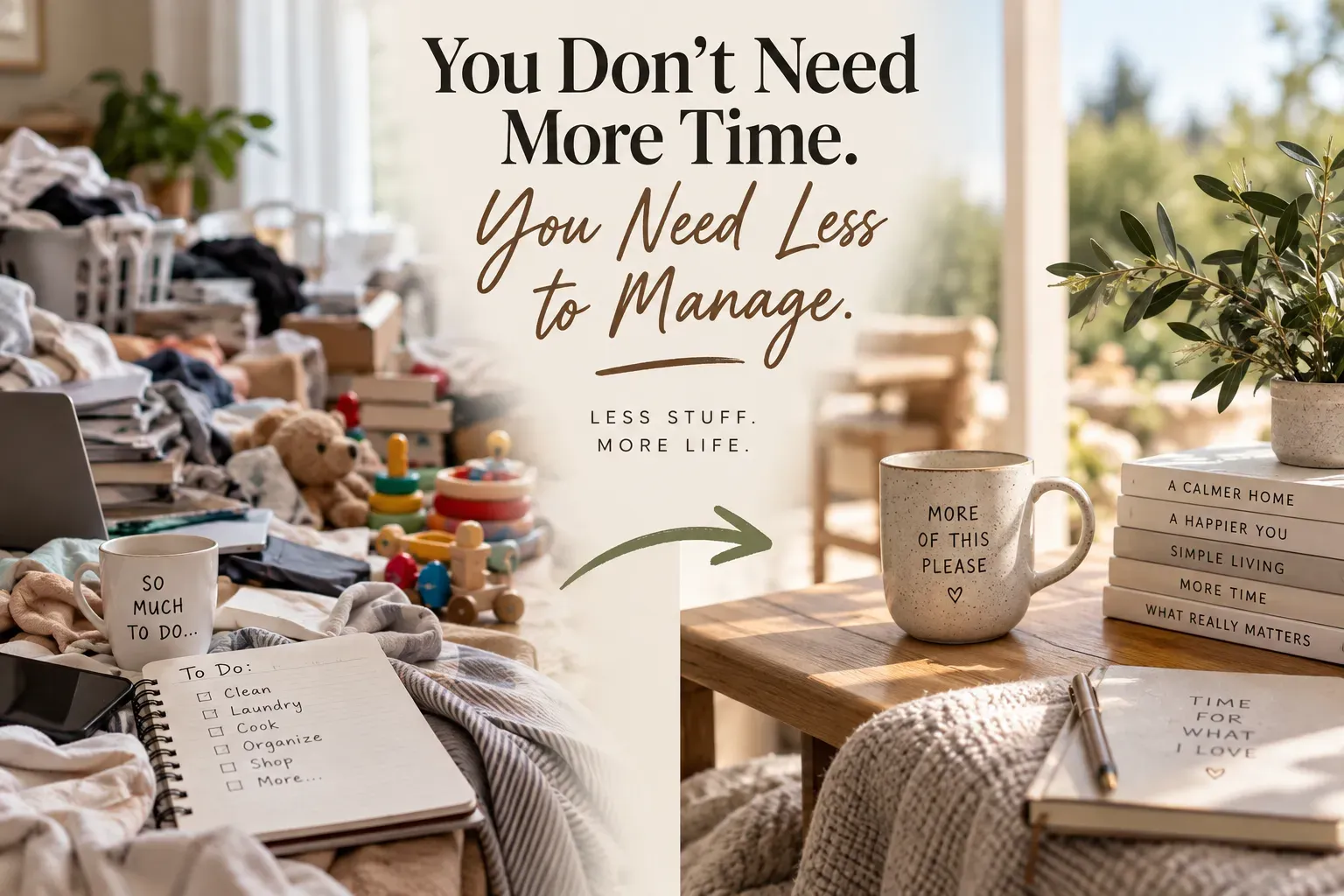
How many times have you heard that you need to manage your time better?
Make a schedule. Create a cleaning routine. Organize your closets. Meal prep. Fold everything properly. Buy containers. Label the containers. Create a system for the containers.
Especially as mothers, we are constantly looking for ways to fit more into the same 24 hours.
But after raising five children and managing a home for many years, I have come to look at time management very differently.
I don't manage my time so I can do more. I manage my time so I can do less.
Sometimes you don't need another organization system. You simply need less to manage.
I started learning this lesson when I was pregnant with my first child. I was a new mom with very little experience and no one around to guide me. Like many first-time mothers, I turned to mom groups online.
I asked what I needed. And everyone had an answer.
You need 20 sleepers. You need 50 onesies. You need this kind of stroller. No, you need another stroller too. You need this gadget. You need that baby product. So I listened.
I bought the things everyone told me I needed because I had no idea what I would actually use.
Then my baby arrived, and it didn't take me long to realize that I hadn't purchased enough things for one baby. I had purchased enough things for about ten babies. And that was only the beginning.
When my son became old enough to crawl, walk and interact with toys, I noticed something interesting.
The more toys he had, the less he seemed to actually play.
He would dump them everywhere. Throw them around. Move from one thing to another. And then he would still become fussy.
Having more options wasn't necessarily making him happier. Eventually, I started researching more intentional approaches to children's toys and came across ideas inspired by Waldorf education and simpler play: natural materials, less stimulation, open-ended toys and fewer options available at once.
Instead of needing a different toy for every possible activity, I became interested in toys that could become many things. A simple set of blocks can be a house today, a road tomorrow and a castle the next day.
I also started experimenting with toy rotation. Rather than having everything available at once, I could put some toys away and bring them back later. Suddenly an old toy could feel new again.
The idea that less could actually give my child more fascinated me.
And soon, I started applying it to the rest of my home.
At the time, we lived in a small one-bedroom apartment in New York City. There wasn't much space, yet somehow there was always something to pick up, organize, hang, fold or put away.
I wanted to take my baby outside.
I wanted to go to the park.
I wanted to enjoy the city.
Instead, I kept finding myself managing things.
And the ridiculous part was that I didn't even use much of what I was constantly organizing.
One day, I came across a documentary about minimalism on Netflix. It completely changed the way I looked at my belongings.
Funny enough, I eventually got rid of Netflix too.
But I have to give it credit for that one. 😂
The idea of less is more stuck with me. It has been part of the way I run my home ever since.
We tend to think about the price of something only when we buy it, but our possessions continue charging us long after we leave the store.
They need somewhere to live. They need to be moved. Washed. Folded. Dusted. Organized. Picked up. Stored. Reorganized, and eventually, disposed of. The more you own, the more you have to manage.
That's why I don't want a house filled with decorative objects that I have to pick up every week just to wipe underneath them. I like clean surfaces.
I like open space. I like light colors. I like furniture and materials that are easy to maintain.
My house is mostly whites and light grays because visually, that gives me clarity and peace. I don't want my surroundings to constantly demand my attention.
When I clean a room, I want to be able to wipe the surfaces in a few minutes, vacuum and move on with my life. Because I have other things I'd rather be doing.
The same philosophy applies to my kitchen. Stores will happily sell you a separate gadget for every food you've ever encountered. An apple slicer. An egg slicer. A special tool for this vegetable and another tool for that one.
I have a knife.
It works pretty well. 😂
Maybe I'm old-fashioned. I learned a lot of my kitchen habits from my mother and grandmother, and I don't feel the need to own a specialized object for every little task.
Of course I own kitchen tools and cutting boards. The point isn't to get rid of everything.
The point is to ask:
"Does this object actually make my life easier—or is it simply another object I have to store and manage?"
I still shop. I still enjoy beautiful things. I still buy things for my home, myself and my children.
I'm not trying to live in an empty white room with one chair. But I've become much more intentional about what gets through my front door.
When I see something I like in a store, I usually already know where it would go in my house.
If I don't have a place for it, I put it back. When I think of something I might need during the day, I often write it on the whiteboard on my refrigerator instead of immediately buying it.
Then I wait.
If I keep returning to that item and realizing, Yes, I actually need this, then I'll buy it.
And when I do buy something I expect to use regularly, I would rather invest in one good-quality item than repeatedly buy cheap things that need replacing.
I'm not interested in owning the least amount possible. I'm interested in owning what serves my life.
I've never been much of a Pinterest person. For me, it creates too much noise. You can go online perfectly satisfied with your pantry and come out two hours later convinced that you urgently need matching containers, new labels, storage bins and an entirely redesigned hallway.
Suddenly you're buying more things so you can organize the things you already bought. No, thank you.
Organization has its place. I organize my home too. But organizing too much stuff doesn't solve the problem of having too much stuff.
Your pantry doesn't need to be romanticized.
Your sheets don't need to be arranged by color.
Every drawer doesn't need to look like someone is coming to photograph it tomorrow.
If your house is neat, you can find what you need, and your belongings work for your family, you made it.
Don't copy someone else's home.
Do what works for yours.
Before having children, I could spend forever doing things that I now find completely unnecessary.
I used to match socks, fold them together and stack them nicely. I folded underwear a certain way.
Why? I don't know. Apparently I had time. 😂 I don't do that anymore. Socks go in the drawer. Underwear goes in the drawer. Done.
I hang most of our regular clothes. Pajamas and lounge clothes get folded, but I'm not spending hours creating beautiful drawers nobody sees.
Having fewer clothes makes this much easier. My children also don't need enormous wardrobes. My oldest child usually gets the most new everyday clothing, and many good pieces are handed down to his younger brothers. I have baby clothes from my first child that I'm now using with my fourth and fifth babies—my twins. If something is clean, comfortable and still in good condition, I don't care that another brother wore it first.
Having more children hasn't made me abandon this philosophy. If anything, it has made it more important.
I now have five boys.
Imagine how much stuff could enter this house if I kept everything from every child. We go through their rooms and clothing regularly. Things they don't use or wear leave. Good clothing can be stored for the next growing child. Things that aren't worth keeping are donated or discarded.
We don't keep every piece of artwork.
We keep the special ones.
We don't save wrapping paper just because maybe one day we'll need it.
It served its purpose. Goodbye.
I don't buy piles of birthday decorations that will sit in storage for the next five years.
And my children understand that we don't have to physically keep everything we've ever touched in order to remember our childhood.
Some of the best things we keep are memories.
That doesn't mean children should be forced to throw away everything they love. Kids need help making these decisions. Even my oldest, who is 11, sometimes needs me beside him when we're going through his room. Children can have a difficult time deciding what is meaningful and what they're simply keeping because it's there. So sometimes we do it together.
I don't wait until January to announce that I'm going to declutter my entire life.
It happens continuously.
I have a place where unwanted things can go. If something isn't being used, it can sit there for a while. Sometimes we realize we actually need it and take it back.
If not, it eventually leaves.
I may sell something valuable. I may give it to someone who needs it. I may donate it. And if it's genuinely no longer useful, I throw it away.
Something is always leaving my house. Of course, things are also coming in. That's life.
The goal isn't to stop consuming completely. The goal is to stop accumulating without thinking.
Time Management Isn't About Doing the Most
This is where minimalism and time management connect for me.
A lot of productivity advice seems to be about figuring out how much work we can possibly squeeze into one day. How much can I clean? How many loads of laundry can I finish? How many meals can I prep? How early can I wake up? How efficiently can I organize my children's things?
That's not the kind of time management I want. I don't want to become incredibly efficient at spending my entire life doing chores. I want to reduce the chores.
If there are fewer things on my surfaces, dusting is faster.
If there are fewer clothes, laundry is easier.
If there are fewer toys, there is less to pick up.
If everything has a home, I don't spend my evening walking around returning random objects to random rooms.
Use something. Put it back. Simple.
My dishwasher generally runs once a day, even in a family with five children.
My house doesn't require me to constantly organize it because I don't want to own enough things to create that problem.
And yes, there are messy days. Sometimes the laundry waits. Sometimes the dishes pile up. Sometimes life happens.
That's okay.
I'm not trying to maintain a museum.
I'm trying to maintain a home that serves the people living in it.
I sit outside in the morning with a cup of coffee. I listen to the birds and look at the trees. I read nonfiction and personal-development books. I listen to educational lectures. I learn. I go walking. I enjoy nature and hiking. I meet my friends. I go to coffee shops. I work on my education, businesses and hobbies.
Over the years, I've had the time and mental space to build several businesses from home while raising my children.
How are you supposed to explore an idea, learn a skill or build something of your own when you barely have time to breathe? And sometimes I use my free time to do absolutely nothing. I love that too.
Right now, as I'm working on this article, my newborn twins are napping.
I could probably find something in my house to clean. There is always something you could be doing when you have children. But I'm writing. I'll cook later. Right now, I choose me.
That's what I wanted all this simplicity for.
Not so I could have the most organized house.
So I could have a life inside it.
Whenever I visit friends, I'm known for telling them they need to declutter. Some even call me for advice about decorating or figuring out where to store things. But if your house currently feels overwhelming, please don't wake up Saturday morning and decide you're going to declutter the entire thing.
You'll pull everything out.
Six hours later, you'll be sitting on the floor surrounded by piles wondering why you ever started.
Instead, set a timer for 30 minutes.
Choose one drawer.
Not your house.
Not your kitchen.
One drawer.
Make yourself a cup of coffee. Put on music. Call a friend or invite someone over to keep you company.
Then start.
When the timer ends, stop.
Even if you suddenly feel motivated to conquer another three rooms, you don't have to.
Come back another day.
Decluttering shouldn't become another enormous chore you dread. Make it pleasant.
Thirty minutes here.
One drawer there.
One shelf next week.
And while you're slowly removing what doesn't serve you, become more careful about what you bring back in.
Eventually, you'll notice something. Cleaning gets faster. Putting things away gets easier. Your rooms feel calmer. You know where things are. And little pieces of your time start coming back to you. Don't immediately fill them. Sit outside.
Drink your coffee while it's still hot.
Read something.
Take your children to the park.
Work on the idea you've been thinking about for three years.
Take a nap.
Do absolutely nothing.
You don't need to justify every free minute by finding another productive thing to put inside it.
The goal of managing your time isn't to fit more work into your life.
Sometimes the goal is simply to get more of your life back.
With Love, Alena Assaad.